Salgenx LLC • Design • Develop • Analysis TEL: 1-608-238-6001 Email: greg@salgenx.com
Salgenx Research and Development Acquisition We are now focussing on the AI Data Centers and supercritical CO2 power generation. The Salgenx Project is available for acquisition, including all intellectual property. More Info
|
|
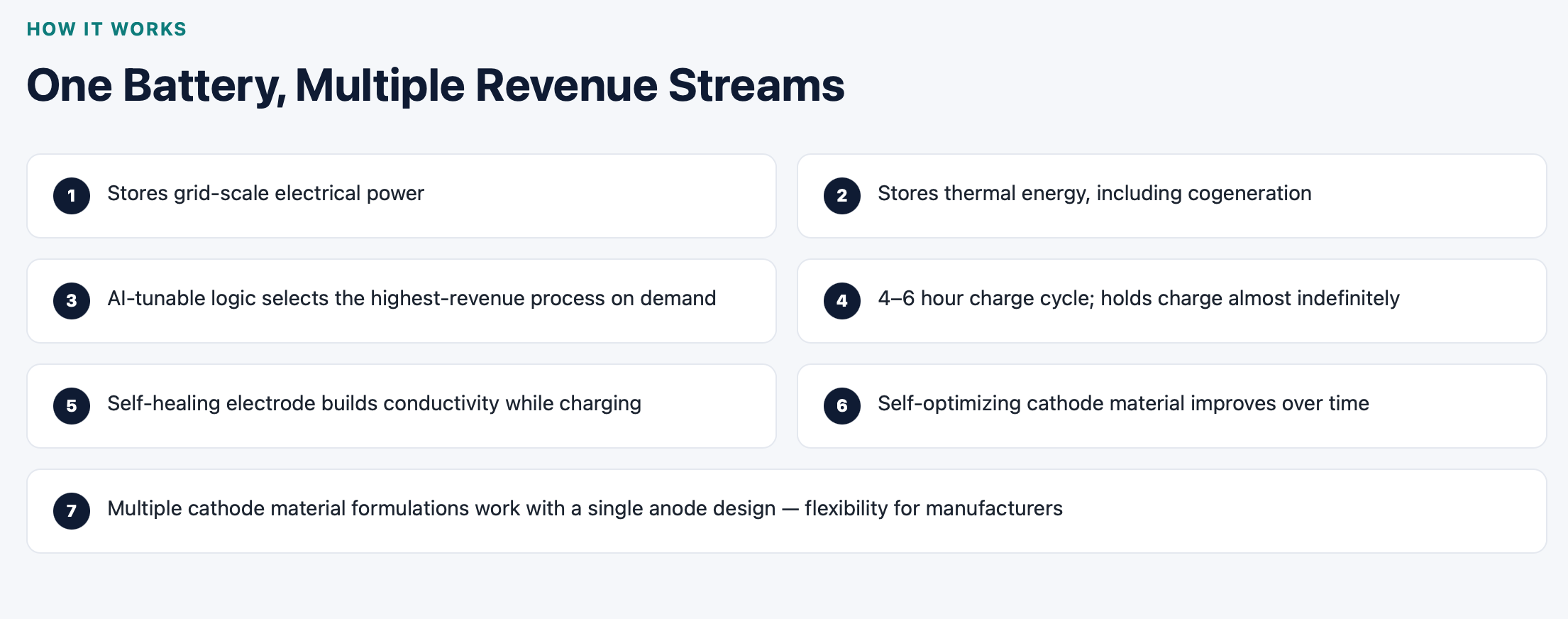
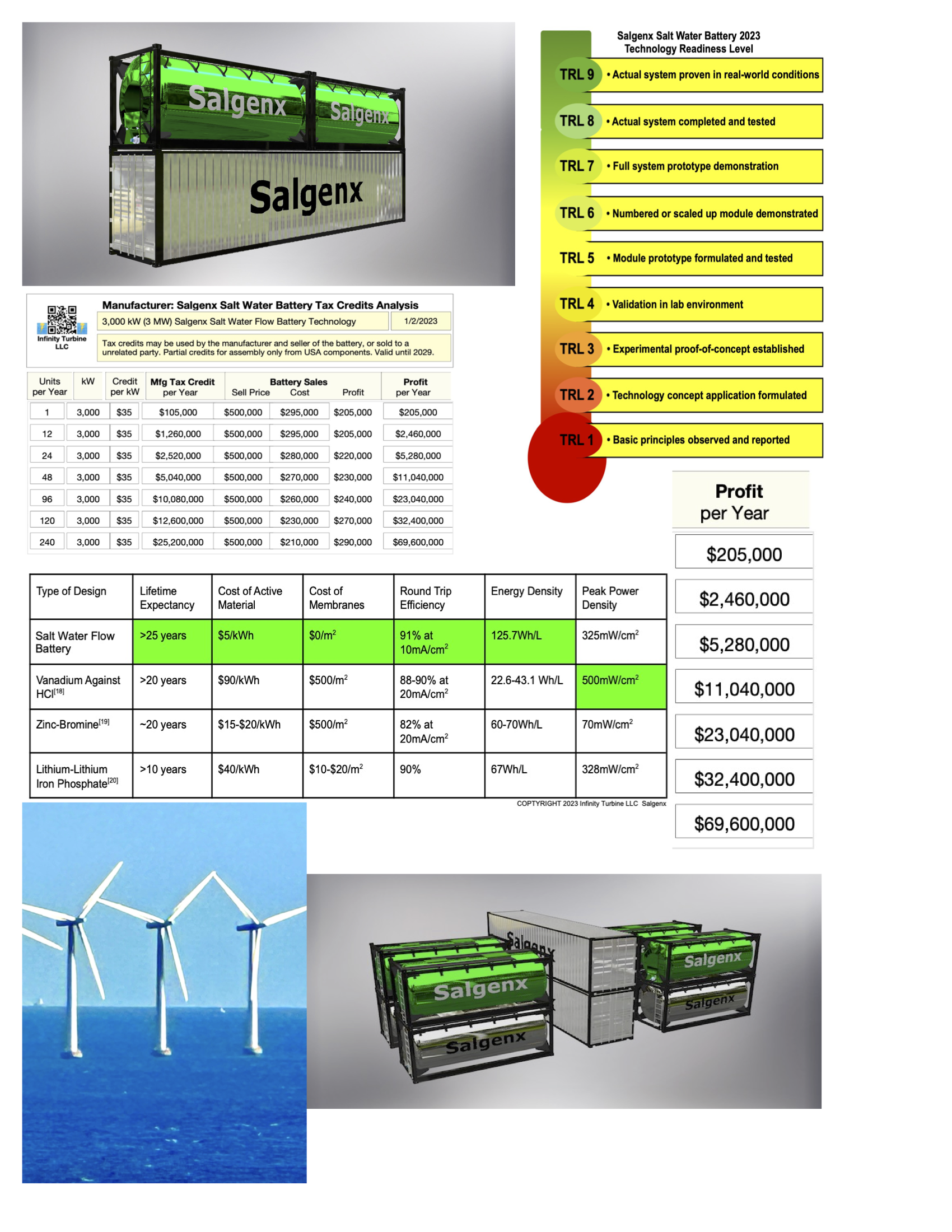
We design the Technology. You Build and Commercialize the Product. The Salgenx sodium flow battery is unique, in that it can not only store electricity, but perform simultaneous processing functions.• Store grid-scale power • Store thermal energy (including cogeneration)• Perform selectable revenue processes according to highest revenue on-demand (AI tunable logic may select from charging to thermal storage, and more)• Build for less than $300,000 for a 3-6 MWh System• Use pre-made (new or used) shipping containers for the battery saltwater and electrolyte storage• The only fabrication are the flow pumps and electrolyzers which you may purchase pre-made to assemble at your location• Low cost Zinc based electrode materialThe 6 hour flow battery charge rate can be discharged at any time and the stored energy can be held almost indefinitely.$35/kWh USA Battery Tax Credit (paid directly from IRS or may be sold to unreleated party) amounts to $150,000 per 3,000 kWh battery. That is about half of the production cost.The Company That Controls Battery Technology Controls the World |
|
|
Is Saltwater Flow Battery Dead after CATL has gone into production of the Sodium Ion Battery ? Sodium ion batteries developed by CATL are gaining attention for consumer and mobility applications, but they do not replace the unique strengths of saltwater flow batteries. From unlimited cycle life to non-flammable electrolytes and independent scaling of power and energy, saltwater flow batteries continue to provide compelling advantages for large scale and long duration energy storage systems.Read More About Advantages of Saltwater Flow Batteries Compared to Sodium Ion Technology |
|
The Two-Year Problem Hiding in a Twenty-Year Industry AI chips burn bright and fast—often obsolete in just two years—yet the data centers that house them are locked into leases and financing structures lasting decades. This deep dive exposes the growing mismatch between ultra-short hardware life and long-term financial commitments in the AI infrastructure boom. From stranded facilities to SPV risk cascades, we explore how today’s rapid chip churn could collide with tomorrow’s 20-year obligations—and what happens when the economics of AI finally slow down.The Two-Year Chip vs. the 20-Year Lease: The Hidden Fragility of AI Data Center Financing |
|
The New AI Gold Rush: Compute Now, Own Later AI data centers are exploding in size—and in hidden risk. Behind the shiny GPU racks, much of today’s AI infrastructure is financed off-balance sheet through leases and opaque SPVs, with Meta’s Hyperion campus as the flagship example. This article unpacks how that Enron-style financial engineering shapes decisions about cooling, energy efficiency, and waste-heat recovery—and why leased facilities may be slow to adopt breakthrough technologies. It also explores what happens if AI revenues falter while long-term lease obligations keep piling up. Are we quietly building the next leverage bubble in the cloud?AI Data Centers, Hidden Leverage and the Leasing Game: Lessons From Meta’s Hyperion Strategy |
|
The Opportunity to Build and Sell a Grid-Scale Sodium Flow Battery and Make $600,000 Income Per Day with a Production of only 2 Batteries Per Day Consult with Salgenx and manufacture the batteries to ship anywhere in the world. You own the IP you develop.We can provide you with customers through our website and network of pre-existing customers.While we continue to develop and enhance the saltwater battery features together, you deploy to the market and take profits. |
Build Your Own Brand |
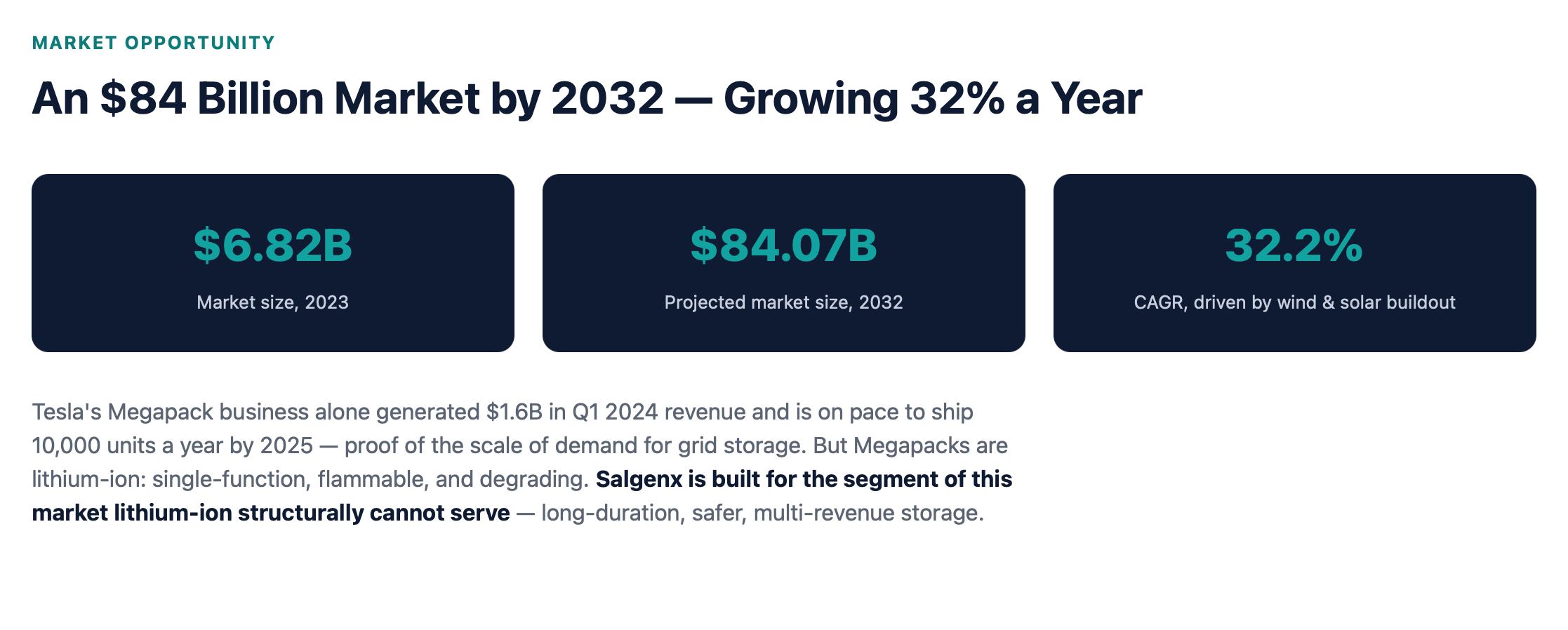
CATL Sodium Ion vs Saltwater Flow Battery Salgenx is not competing with lithium or sodium-ion batteries on short-duration price or energy density; it is purpose-built for long-duration, non-flammable, serviceable energy storage where safety, lifetime throughput, and resilience matter more than compact packaging. By decoupling power from energy through a saltwater flow architecture, Salgenx enables economical six to twenty-four hour storage, simplified permitting near occupied buildings, and long service life through stack refurbishment rather than full battery replacement. As sodium-ion batteries accelerate adoption in commodity one to four hour applications, Salgenx occupies a defensible niche as energy infrastructure for commercial, industrial, municipal, and microgrid customers seeking dependable, long-life storage with lower risk, predictable operating costs, and expandable capacity over time.Salgenx is intentionally not positioned as a universal battery solution. Salgenx clearly identifies applications where short-duration, high–energy-density batteries such as lithium-ion or sodium-ion are the better choice, including space-constrained sites, one to four hour peak shaving, and fast-deploy portable systems. By explicitly defining where Salgenx is not the optimal fit, they are a trusted long-duration energy infrastructure partner rather than a commodity battery vendor. |
Advanced Electrolyzer Design Has Potential of Graphene (reduction of Graphite) and Cement Production (reduction of limestone without CO2 emissions) Simultaneously While Charging |
Fastest Path to a 3 MWh Grid-Scale Saltwater Flow Battery: Zinc-Chlorine vs NTP-Based Architectures Which saltwater flow battery chemistry reaches grid-scale commercialization first? This article compares zinc metal and NTP-based chlorine flow batteries across cost, efficiency, manufacturing complexity, and bankability to determine the fastest and most cost-effective path to a 3 MWh system.IntroductionGrid-scale energy storage increasingly demands systems that are safe, low-cost, scalable, and free from constrained materials. Saltwater flow batteries, particularly chlorine-based systems, have re-emerged as a compelling alternative to lithium-ion due to their use of abundant materials, non-flammable electrolytes, and long cycle life.Recent research has demonstrated a membrane-free chlorine flow battery architecture with exceptionally low projected material cost. Within this platform, two negative electrode strategies emerge as candidates for commercialization:1. Zinc metal negative enabled by a ZnCl2 additive2. NaTi2(PO4)3 (NTP) intercalation negative without zinc additiveThis article evaluates both approaches for a 3,000 kWh grid-scale containerized system and determines which offers the fastest, lowest-risk, and most cost-effective path to market.System Architecture OverviewBoth battery variants share a common core architecture:• Aqueous NaCl electrolyte• Chlorine redox at the positive electrode• Closed-loop chlorine handling using an immiscible organic carrier• Membrane-free stack design• Modular stacks arranged into a roughly 900 V DC busThe primary difference lies in the negative electrode chemistry and its implications for voltage, efficiency, manufacturing, and cost.Option A: Zinc-Chlorine Flow Battery with ZnCl2 AdditiveElectrochemistry• Positive: Cl2 / Cl minus• Negative: Zn2 plus / Zn metal• Nominal cell voltage: approximately 1.9 VAdding ZnCl2 to the electrolyte enables reversible zinc plating and stripping, replacing the need for a solid-state intercalation cathode.Manufacturing and Commercial Advantages• Zinc metal is a commodity material available as sheet, foil, or plated substrates (it is also available at Home Depot).• Electrode fabrication is simple and scalable• No high-temperature ceramic synthesis or vapor deposition steps• Aligns with historical zinc-halogen battery manufacturing experienceThe zinc electrode can be designed as a serviceable component, enabling predictable maintenance rather than end-of-life replacement.Risks• Zinc dendrite formation must be controlled through current density, flow design, and electrolyte management• Coulombic efficiency must be validated at scaleOption B: Chlorine Flow Battery with NTP CathodeElectrochemistry• Positive: Cl2 / Cl minus• Negative: NaTi2(PO4)3 (NTP)• Nominal cell voltage: approximately 1.8 VNTP is a NASICON-type insertion material offering good rate capability and stable cycling.Manufacturing and Commercial Challenges• NTP synthesis requires high-temperature calcination• Conductive carbon coating is necessary, typically involving additional thermal processing or vapor deposition• Powder processing and electrode fabrication add complexity and capital costWhile technically elegant, NTP introduces a more complex supply chain and slower ramp to volume production.Costed BOM Comparison for a 3 MWh ContainerUsing the Nature Communications estimate of approximately $5 per kilowatt-hour as a floor for active materials, and legacy zinc-chlorine plant data as a balance-of-plant sanity check, the following system-level costs emerge:• Zinc-Chlorine system total installed cost: approximately xxxxx dollars• NTP-based system total installed cost: approximately xxxxx dollarsThis corresponds to:• Zinc system: approximately xx dollars per kWh installed• NTP system: approximately xxx dollars per kWh installedIn both cases, balance-of-plant, power electronics, and safety systems dominate total cost, not the electrochemistry itself.Efficiency and Cost-Per-Delivered-kWhEfficiency must be evaluated alongside capital cost to assess true economic performance.• NTP-based systems have demonstrated laboratory-scale energy efficiency exceeding 90 percent• Zinc-based systems typically operate in the 70 to 75 percent range when system parasitics are includedWhen adjusted for efficiency:• Zinc system effective cost per delivered kWh: approximately xx to xx dollars• NTP system effective cost per delivered kWh: approximately xx to xxx dollarsThis indicates that while NTP offers higher efficiency, the zinc system compensates with lower upfront cost and faster manufacturability.Fastest Path to Market AssessmentFrom a commercialization standpoint, the decisive factors are manufacturability, supply chain simplicity, and execution risk.• Zinc metal electrodes eliminate the need for specialty ceramic powders and carbon coating processes• Anodes are already mass-produced industrial components• The zinc system supports a service-based maintenance model familiar to utilitiesThe NTP system, while attractive for future optimization, introduces additional process steps that slow time to first deployment.Commercial VerdictFor a first-generation, grid-scale saltwater flow battery:• The zinc-chlorine system with ZnCl2 additive is the fastest to market• It offers the lowest installed cost• It presents the least manufacturing risk• It enables early revenue and field validationThe NTP-based system is best positioned as a second-generation or premium offering once manufacturing scale and customer confidence are established.ConclusionSaltwater flow batteries based on chlorine chemistry present a credible, scalable alternative to lithium-ion for long-duration grid storage. Between the two leading negative electrode options, zinc metal offers the most direct path to commercialization for a 3 MWh containerized system. Its simplicity, cost advantage, and alignment with existing industrial practices outweigh the efficiency advantage of NTP in early deployments.A dual-track strategy is recommended: deploy zinc-based systems first to capture market share and operational data, while continuing development of NTP-based systems for future high-efficiency products.References1. Hou et al. High Energy and Low Cost Membrane Free Chlorine Flow Battery. Nature Communications, 2022.2. Detroit Edison and Energy Development Associates. Zinc Chlorine Battery Utility Study and Cost Analysis, 1976 to 1977.3. Bard and Faulkner. Electrochemical Methods Fundamentals and Applications. Wiley.4. U.S. Department of Energy. Grid Energy Storage Technology and Cost Characterization Reports.
|
|
| CONTACT TEL: +1 608-238-6001 (Chicago Time Zone) Email: greg@salgenx.com | AMP | PDF | Salgenx is a division of Infinity Turbine LLC |