Salgenx LLC • Design • Develop • Analysis • Grid Scale Flow Battery
TEL: 1-608-238-6001 (Chicago Time Zone )
Email: greg@infinityturbine.com
3 MWh Grid Scale Saltwater Flow Battery that is Self Healing Consulting and Analysis Available More Info
Saltwater Flow Battery Technology Development Kit (TDK) Register your own IP with our package. Finish your own cathode then own your IP, then manufacture. Continue development of Volumetric Energy Density of 600 – 900 Wh/L. Buy sales leads, license or buy Salgenx name for your own production. More Info
Salgenx is a modular saltwater electrochemical platform for producing grid-scale chemicals, hydrogen, and synthetic fuel feedstocks.
__________________________________________________________________________________________
|
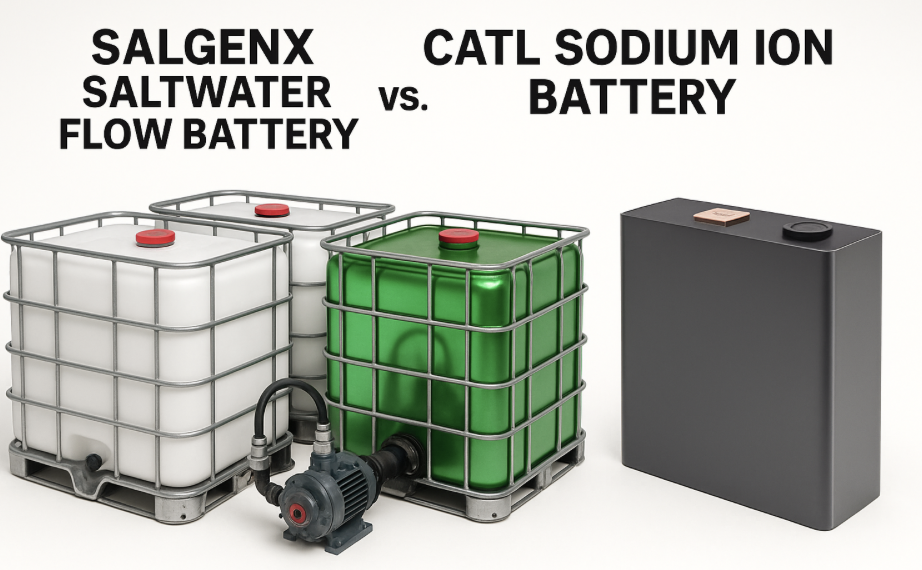
Is Saltwater Flow Battery Dead after CATL has gone into production of the Sodium Ion Battery ? The rapid development of sodium ion battery technology has raised important questions about the future of alternative energy storage platforms. While sodium ion cells offer safety and cost improvements over lithium ion systems, particularly for short duration storage and mobility applications, they do not diminish the value of saltwater flow batteries. These two technologies serve different needs, and saltwater flow batteries retain several critical advantages for grid level and long duration storage.One of the defining benefits of a saltwater flow battery is its long service life. Because the electrochemical reactions occur in a flowing liquid electrolyte rather than within fixed solid electrodes, degradation is minimal. Flow battery systems can cycle thousands or even tens of thousands of times without losing capacity, allowing for decades of reliable daily cycling. Sodium ion batteries, while robust, still experience electrode fatigue, plating, and structural changes that limit their cycle life compared to flow designs.Scalability is another major distinction. Sodium ion batteries, like all traditional cell based storage, package power and energy in fixed ratios defined during manufacturing. In contrast, saltwater flow batteries allow users to scale energy capacity simply by increasing electrolyte volume, while power output is determined separately by the size and number of cell stacks. This independent scaling is ideal for applications requiring long discharge durations, flexible power ratings, or future capacity expansion at minimal cost.Safety is also a significant advantage of saltwater flow batteries. Their water based electrolytes are completely non flammable, eliminating the risk of thermal runaway or fire. This makes them suitable for installation in occupied buildings, underground facilities, industrial areas, and remote sites where enhanced safety is crucial. Sodium ion cells are safer than lithium ion devices, but they still rely on solid state chemistries that can generate heat and require thermal management.Material availability further strengthens the case for saltwater flow batteries. These systems can use abundant, low cost materials such as sodium chloride, zinc chloride, or iron chloride solutions alongside commodity grade components. Unlike sodium ion cells, which require specialized anode and cathode materials and precise manufacturing conditions, saltwater flow batteries can be produced using widely accessible ingredients and standard industrial equipment. This reduces supply chain risk and enables local manufacturing in regions with limited access to high tech cell production.In addition, saltwater flow batteries operate effectively across a broad temperature range and do not require active cooling systems. They tolerate full depth of discharge without damaging the system, which is particularly important for renewable energy integration where daily cycling patterns vary. The ability to discharge to zero percent and restore full functionality repeatedly is a key advantage for solar, wind, and microgrid applications.Taken together, these attributes make saltwater flow batteries well suited for four to twenty four hour energy storage, load leveling, resilience planning, and grid support. Sodium ion batteries remain an excellent option for portable systems, electric mobility, and short duration storage. However, the structural benefits of saltwater flow batteries provide an enduring advantage in large scale energy management, long duration storage, and safe, cost effective deployment.Saltwater flow batteries and sodium ion batteries each serve specific roles in the evolving energy landscape. Far from being replaced, flow batteries remain an essential technology for stable, safe, and scalable energy storage across industrial, commercial, and grid level applications. |
|
|
Updated on 12/14/2025 CATL’s low-cost sodium-ion progress is not the death of a saltwater flow battery concept, but it does raise the bar on cost, bankability, and execution for any stationary-storage product that is not already scaling.What CATL has actually put on the record (and what is still marketing noise) CATL publicly launched its Naxtra sodium-ion line in April 2025 and stated mass production would begin in December 2025, with claimed energy density around 175 Wh/kg and long cycle-life claims. ([Reuters][1]) Very low dollars per kWh numbers circulating online (for example, $10–$19 per kWh) are widely repeated, but they vary by source and are not consistently documented as an audited, all-in installed system cost. Treat those as headline claims, not a bankable benchmark, until there is broad third-party confirmation in shipped products and project EPC pricing. ([Circular Business Review][2]) Independent commentary has also pointed out that sodium-ion adoption is not guaranteed to explode simply because it is cheaper than lithium, especially if lithium prices remain soft and if sodium-ion performance tradeoffs persist. ([Financial Times][3])So, sodium-ion is a serious competitive development—but it does not eliminate the structural advantages of flow batteries in the applications where flow batteries win.Where sodium-ion is genuinely threateningSodium-ion (especially from a scale player like CATL) is most threatening in: Short-duration stationary storage (1–4 hours) where energy density, packaged simplicity, and high round-trip efficiency matter. Behind-the-meter batteries where footprint, installation speed, and standardized box product deployment are key. Cold-weather performance use cases (CATL is explicitly emphasizing low-temperature capability). ([CATL][4])If a customer’s decision is mainly lowest upfront $ per kWh for a containerized battery, for 2 hours, sodium-ion will be a strong contender.The defensible reasons a saltwater flow battery still has a marketA saltwater flow battery (and flow batteries generally) competes on a different axis than cell-based chemistries:1. Safety and siting flexibility Flow batteries use water-based electrolytes and are widely characterized as non-flammable and intrinsically safer to site near buildings or sensitive infrastructure. ([Battery Council International][5]) Even when sodium-ion is safer than many lithium-ion chemistries, it is still a dense, packaged cell system that typically requires more conventional battery safety design, thermal management, and hazard zoning.2. Long-duration economics by design Flow batteries decouple power (stack size) from energy (tank volume). That means if a customer needs 8, 12, or 24 hours, you scale tanks rather than buying proportionally more power hardware. This is a fundamental architectural advantage in long-duration storage. Industry summaries commonly position flow batteries as a strong fit for 4–12+ hour duty and long-duration grid support. ([Battery Council International][5])3. Cycle life and degradation profile (high-throughput use cases) Peer-reviewed literature commonly describes flow batteries as having long service life (often measured in decades) and cycle life that can be very high, with typical round-trip efficiency ranges often cited around 65–85% depending on chemistry and system design. ([ScienceDirect][6]) For customers doing heavy cycling (multiple cycles per day, frequent partial cycling, or harsh operating profiles), the degradation and replacement economics of cell packs can dominate total cost of ownership. Flow can be marketed around maintainability and lifetime throughput, provided the design is robust.4. Serviceability and refurb economics Flow systems can be designed so that stacks, pumps, sensors, and electrolyte handling are serviceable without replacing the whole battery. This becomes a business model advantage if you can offer uptime guarantees and low-cost refurbishment.Benefits of a saltwater flow battery compared to a sodium-ion batteryHere is the cleanest positioning (assuming you execute well technically):Saltwater flow battery advantages Best fit for 6–24 hour applications where energy scaling via tanks wins. Intrinsic non-flammability and easier siting (especially valuable for permitting and insurance). ([Battery Council International][5]) Potentially excellent lifetime throughput and long service life in stationary duty. ([ScienceDirect][6]) Materials story: abundant, non-critical, recyclable, aqueous resonates for certain buyers (municipal, campuses, ESG-driven industrials).Sodium-ion advantages (especially CATL-class supply chain) Higher energy density and simpler packaged deployment for short-duration storage. Likely higher round-trip efficiency at the system level in many mainstream deployments (project-dependent, but typical of packaged cell systems). Very strong manufacturing scale, quality systems, and bankability—CATL’s real advantage is not just chemistry, it is industrialization and financing confidence. ([Reuters][1])Is there hope to market and sell Salgenx-class saltwater flow batteries?Yes, but not by trying to out-CATL CATL on commodity battery box pricing.A workable go-to-market thesis for Salgenx-style saltwater flow is: Own long-duration behind-the-meter and microgrid resiliency: 8–24 hours, where customers are buying keep the site running rather than optimize capex per kWh. Sell safety and siting: markets with strict fire codes, indoor/adjacent-to-occupancy installations, insurance-driven decision makers. Industrial customers with cycling and uptime needs: demand-charge management plus long-duration backup, renewables firming, process continuity. Modular tank plus stack architecture: emphasize expandability (add electrolyte/tanks later) and service contracts.The practical constraint: you will need credible, third-party-validated answers on: Installed cost (all-in EPC), not just materials Round-trip efficiency at rated power and across temperature Degradation and maintenance intervals Safety testing and permitting pathway Supply chain and manufacturability planIf you want, I can translate this into a concise positioning document for Salgenx that includes (1) the where we win application map, (2) competitive traps to avoid versus sodium-ion, and (3) the minimum performance and cost metrics you need to publish to be taken seriously by commercial and municipal buyers.[1]: https://www.reuters.com/technology/chinese-battery-maker-catl-launches-second-generation-fast-charging-battery-2025-04-21/ China's CATL launches new sodium-ion battery brand[2]: https://www.circularbusinessreview.com/catls-19-kwh-sodium-ion-claims-face-reality-check-in-1-82-billion-market/ CATL's $19/kWh Sodium-Ion Claims Face Reality Check in ...[3]: https://www.ft.com/content/76cce65f-b0f1-4334-b151-0e12dd37aaa6 Are salt batteries the future?[4]: https://www.catl.com/en/news/6585.html Propelling the New Energy Industry to Accelerate Its Entry ...[5]: https://batterycouncil.org/battery-facts-and-applications/essential-applications/stationary-energy-storage/ Stationary Energy Storage[6]: https://www.sciencedirect.com/science/article/pii/S1364032122001368 A comprehensive review of stationary energy storage ... f |
|
CATL Competition Salgenx is not competing with lithium or sodium-ion batteries on short-duration price or energy density; it is purpose-built for long-duration, non-flammable, serviceable energy storage where safety, lifetime throughput, and resilience matter more than compact packaging. By decoupling power from energy through a saltwater flow architecture, Salgenx enables economical six to twenty-four hour storage, simplified permitting near occupied buildings, and long service life through stack refurbishment rather than full battery replacement. As sodium-ion batteries accelerate adoption in commodity one to four hour applications, Salgenx occupies a defensible niche as energy infrastructure for commercial, industrial, municipal, and microgrid customers seeking dependable, long-life storage with lower risk, predictable operating costs, and expandable capacity over time. |
| CONTACT TEL: +1 608-238-6001 (Chicago Time Zone) Email: greg@infinityturbine.com | AMP | PDF | Salgenx is a division of Infinity Turbine LLC |