Search Tesla Megapack Publications search was updated real-time via Filemaker on:
Page | 017 CPUC Energy Storage Procurement Study: Safety Best Practices Attachment F
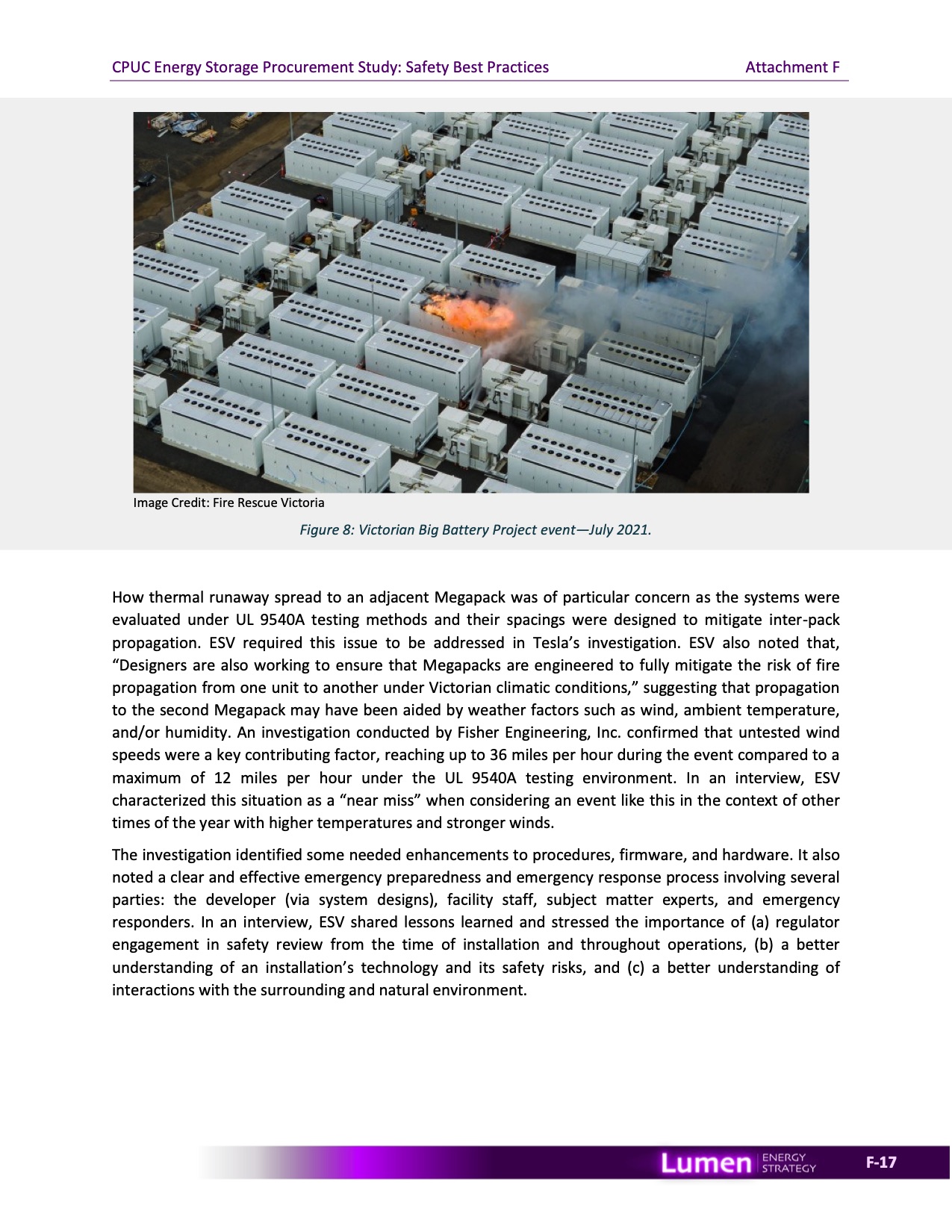
Image Credit: Fire Rescue Victoria
Figure 8: Victorian Big Battery Project event—July 2021.
How thermal runaway spread to an adjacent Megapack was of particular concern as the systems were evaluated under UL 9540A testing methods and their spacings were designed to mitigate inter-pack propagation. ESV required this issue to be addressed in Tesla’s investigation. ESV also noted that, “Designers are also working to ensure that Megapacks are engineered to fully mitigate the risk of fire propagation from one unit to another under Victorian climatic conditions,” suggesting that propagation to the second Megapack may have been aided by weather factors such as wind, ambient temperature, and/or humidity. An investigation conducted by Fisher Engineering, Inc. confirmed that untested wind speeds were a key contributing factor, reaching up to 36 miles per hour during the event compared to a maximum of 12 miles per hour under the UL 9540A testing environment. In an interview, ESV characterized this situation as a “near miss” when considering an event like this in the context of other times of the year with higher temperatures and stronger winds.
The investigation identified some needed enhancements to procedures, firmware, and hardware. It also noted a clear and effective emergency preparedness and emergency response process involving several parties: the developer (via system designs), facility staff, subject matter experts, and emergency responders. In an interview, ESV shared lessons learned and stressed the importance of (a) regulator engagement in safety review from the time of installation and throughout operations, (b) a better understanding of an installation’s technology and its safety risks, and (c) a better understanding of interactions with the surrounding and natural environment.
F-17
|
