Page | 002 For example, small cameras worn by workers (e.g., police and security personnel), as shown in Image 2, can cause burns or other serious injury if the lithium battery catches fire or explodes while worn. To prevent injury, it is important for employers and workers to understand a lithium-powered device’s basic function, hazards, and safe use.
How Lithium Batteries Work
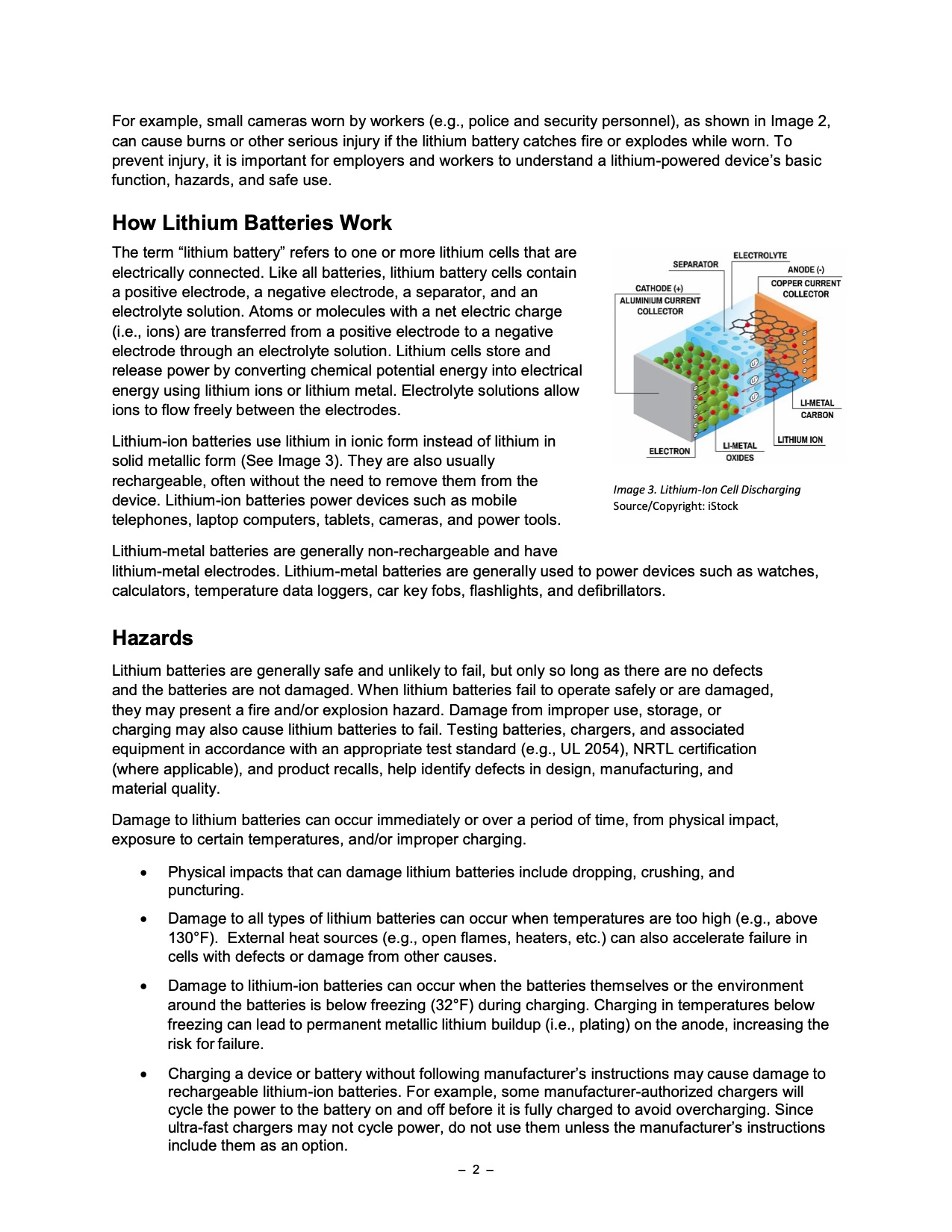
The term “lithium battery” refers to one or more lithium cells that are electrically connected. Like all batteries, lithium battery cells contain a positive electrode, a negative electrode, a separator, and an electrolyte solution. Atoms or molecules with a net electric charge (i.e., ions) are transferred from a positive electrode to a negative electrode through an electrolyte solution. Lithium cells store and release power by converting chemical potential energy into electrical energy using lithium ions or lithium metal. Electrolyte solutions allow ions to flow freely between the electrodes.
Lithium-ion batteries use lithium in ionic form instead of lithium in solid metallic form (See Image 3). They are also usually rechargeable, often without the need to remove them from the device. Lithium-ion batteries power devices such as mobile telephones, laptop computers, tablets, cameras, and power tools.
Image 3. Lithium-Ion Cell Discharging
Source/Copyright: iStock
Lithium-metal batteries are generally non-rechargeable and have
lithium-metal electrodes. Lithium-metal batteries are generally used to power devices such as watches, calculators, temperature data loggers, car key fobs, flashlights, and defibrillators.
Hazards
Lithium batteries are generally safe and unlikely to fail, but only so long as there are no defects and the batteries are not damaged. When lithium batteries fail to operate safely or are damaged, they may present a fire and/or explosion hazard. Damage from improper use, storage, or charging may also cause lithium batteries to fail. Testing batteries, chargers, and associated equipment in accordance with an appropriate test standard (e.g., UL 2054), NRTL certification (where applicable), and product recalls, help identify defects in design, manufacturing, and material quality.
Damage to lithium batteries can occur immediately or over a period of time, from physical impact, exposure to certain temperatures, and/or improper charging.
• Physical impacts that can damage lithium batteries include dropping, crushing, and puncturing.
• Damage to all types of lithium batteries can occur when temperatures are too high (e.g., above 130°F). External heat sources (e.g., open flames, heaters, etc.) can also accelerate failure in cells with defects or damage from other causes.
• Damage to lithium-ion batteries can occur when the batteries themselves or the environment around the batteries is below freezing (32°F) during charging. Charging in temperatures below freezing can lead to permanent metallic lithium buildup (i.e., plating) on the anode, increasing the risk for failure.
• Charging a device or battery without following manufacturer’s instructions may cause damage to rechargeable lithium-ion batteries. For example, some manufacturer-authorized chargers will cycle the power to the battery on and off before it is fully charged to avoid overcharging. Since ultra-fast chargers may not cycle power, do not use them unless the manufacturer’s instructions include them as an option.
–2–
|
