Search Completed | Title | Safety of Grid Scale Lithium-ion Battery Energy Storage Systems
Original File Name Searched: EN010106-004026-DL2-Li-ion-BESS-safety-concerns_Redacted.pdf | Google It | Yahoo | Bing
Page | 033 – 32 – June 5, 2021
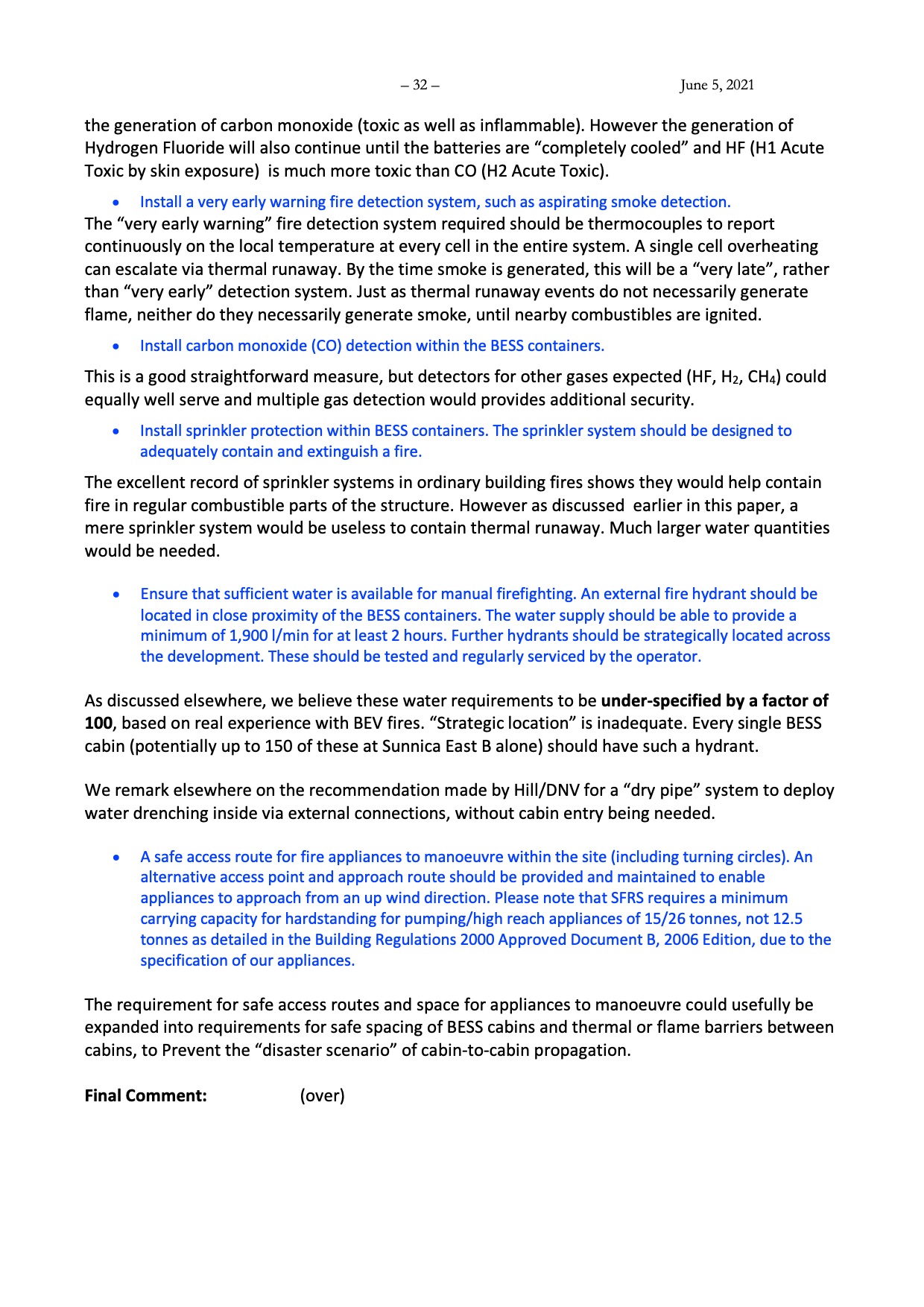
the generation of carbon monoxide (toxic as well as inflammable). However the generation of Hydrogen Fluoride will also continue until the batteries are “completely cooled” and HF (H1 Acute Toxic by skin exposure) is much more toxic than CO (H2 Acute Toxic).
• Install a very early warning fire detection system, such as aspirating smoke detection.
The “very early warning” fire detection system required should be thermocouples to report continuously on the local temperature at every cell in the entire system. A single cell overheating can escalate via thermal runaway. By the time smoke is generated, this will be a “very late”, rather than “very early” detection system. Just as thermal runaway events do not necessarily generate flame, neither do they necessarily generate smoke, until nearby combustibles are ignited.
• Install carbon monoxide (CO) detection within the BESS containers.
This is a good straightforward measure, but detectors for other gases expected (HF, H2, CH4) could
equally well serve and multiple gas detection would provides additional security.
• Install sprinkler protection within BESS containers. The sprinkler system should be designed to adequately contain and extinguish a fire.
The excellent record of sprinkler systems in ordinary building fires shows they would help contain fire in regular combustible parts of the structure. However as discussed earlier in this paper, a mere sprinkler system would be useless to contain thermal runaway. Much larger water quantities would be needed.
• Ensure that sufficient water is available for manual firefighting. An external fire hydrant should be located in close proximity of the BESS containers. The water supply should be able to provide a minimum of 1,900 l/min for at least 2 hours. Further hydrants should be strategically located across the development. These should be tested and regularly serviced by the operator.
As discussed elsewhere, we believe these water requirements to be under-specified by a factor of 100, based on real experience with BEV fires. “Strategic location” is inadequate. Every single BESS cabin (potentially up to 150 of these at Sunnica East B alone) should have such a hydrant.
We remark elsewhere on the recommendation made by Hill/DNV for a “dry pipe” system to deploy water drenching inside via external connections, without cabin entry being needed.
• A safe access route for fire appliances to manoeuvre within the site (including turning circles). An alternative access point and approach route should be provided and maintained to enable appliances to approach from an up wind direction. Please note that SFRS requires a minimum carrying capacity for hardstanding for pumping/high reach appliances of 15/26 tonnes, not 12.5 tonnes as detailed in the Building Regulations 2000 Approved Document B, 2006 Edition, due to the specification of our appliances.
The requirement for safe access routes and space for appliances to manoeuvre could usefully be expanded into requirements for safe spacing of BESS cabins and thermal or flame barriers between cabins, to Prevent the “disaster scenario” of cabin-to-cabin propagation.
Final Comment: (over)
|
