Search Completed | Title | Safety of Grid Scale Lithium-ion Battery Energy Storage Systems
Original File Name Searched: EN010106-004026-DL2-Li-ion-BESS-safety-concerns_Redacted.pdf | Google It | Yahoo | Bing
Page | 014 – 13 – June 5, 2021
initiated rack-to-rack propagation; the only essential factor would have been sufficient heat to trigger thermal breakdown in just one cell in a neighbouring rack. Li-ion cells have been observed to eject molten metal during thermal runaway, another possible mode of propagation over distance. Propagation through a subsequent rack would then occur by exactly the same thermal runaway mechanisms, and potentially beyond between neighbouring cabins in large-scale BESS.
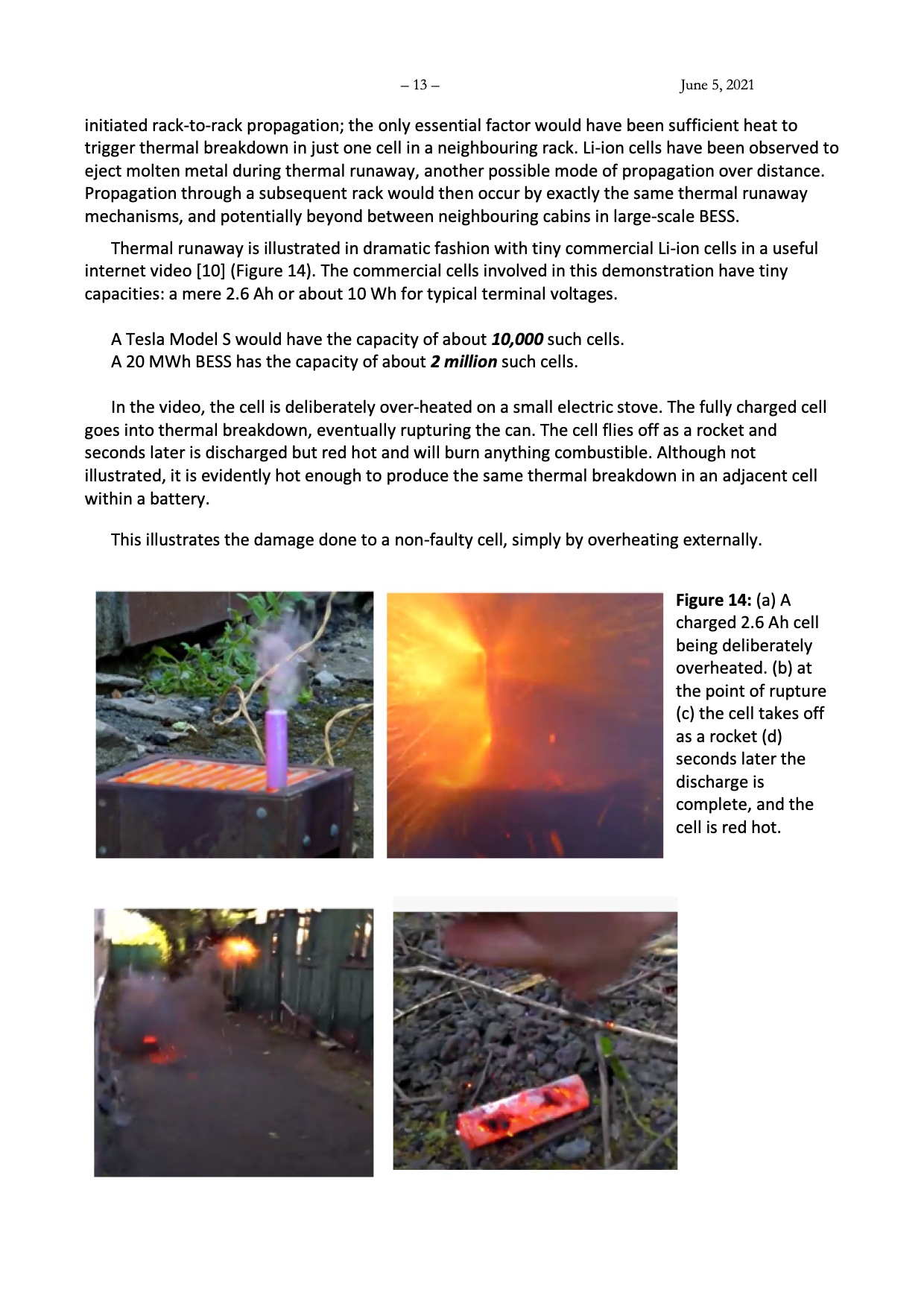
Thermal runaway is illustrated in dramatic fashion with tiny commercial Li-ion cells in a useful internet video [10] (Figure 14). The commercial cells involved in this demonstration have tiny capacities: a mere 2.6 Ah or about 10 Wh for typical terminal voltages.
A Tesla Model S would have the capacity of about 10,000 such cells. A 20 MWh BESS has the capacity of about 2 million such cells.
In the video, the cell is deliberately over-heated on a small electric stove. The fully charged cell goes into thermal breakdown, eventually rupturing the can. The cell flies off as a rocket and seconds later is discharged but red hot and will burn anything combustible. Although not illustrated, it is evidently hot enough to produce the same thermal breakdown in an adjacent cell within a battery.
This illustrates the damage done to a non-faulty cell, simply by overheating externally.
Figure 14: (a) A charged 2.6 Ah cell being deliberately overheated. (b) at the point of rupture (c) the cell takes off as a rocket (d) seconds later the discharge is complete, and the cell is red hot.
|
