Search Completed | Title | Safety of Grid Scale Lithium-ion Battery Energy Storage Systems
Original File Name Searched: EN010106-004026-DL2-Li-ion-BESS-safety-concerns_Redacted.pdf | Google It | Yahoo | Bing
Page | 006 – 5 – June 5, 2021
Regulations 2015. The legal basis for this attitude is unclear – simple calculations summarised in this paper argue that they should be – and the issue may yet be challenged in judicial review.
The reason the COMAH regulations should apply is the scale of evolution of toxic or inflammable gases that will arise in BESS “fires”. In the Drogenbos incident (2017, Table 1), the inhabitants of Drogenbos and surrounding towns were asked to keep all windows and doors shut; 50 emergency calls were made from people with irritation of the throat and airways1. A chemical cloud which “initially had been enormous”, was charted by helicopter. The Belgian Fire Services could not control what was described as “the chemical reaction” and filled the cabin with water. Fears of an explosion with 20 metre flames kept people confined for an hour. Although the initial visible flames were controlled quickly, cooling continued over the next 36 hours.
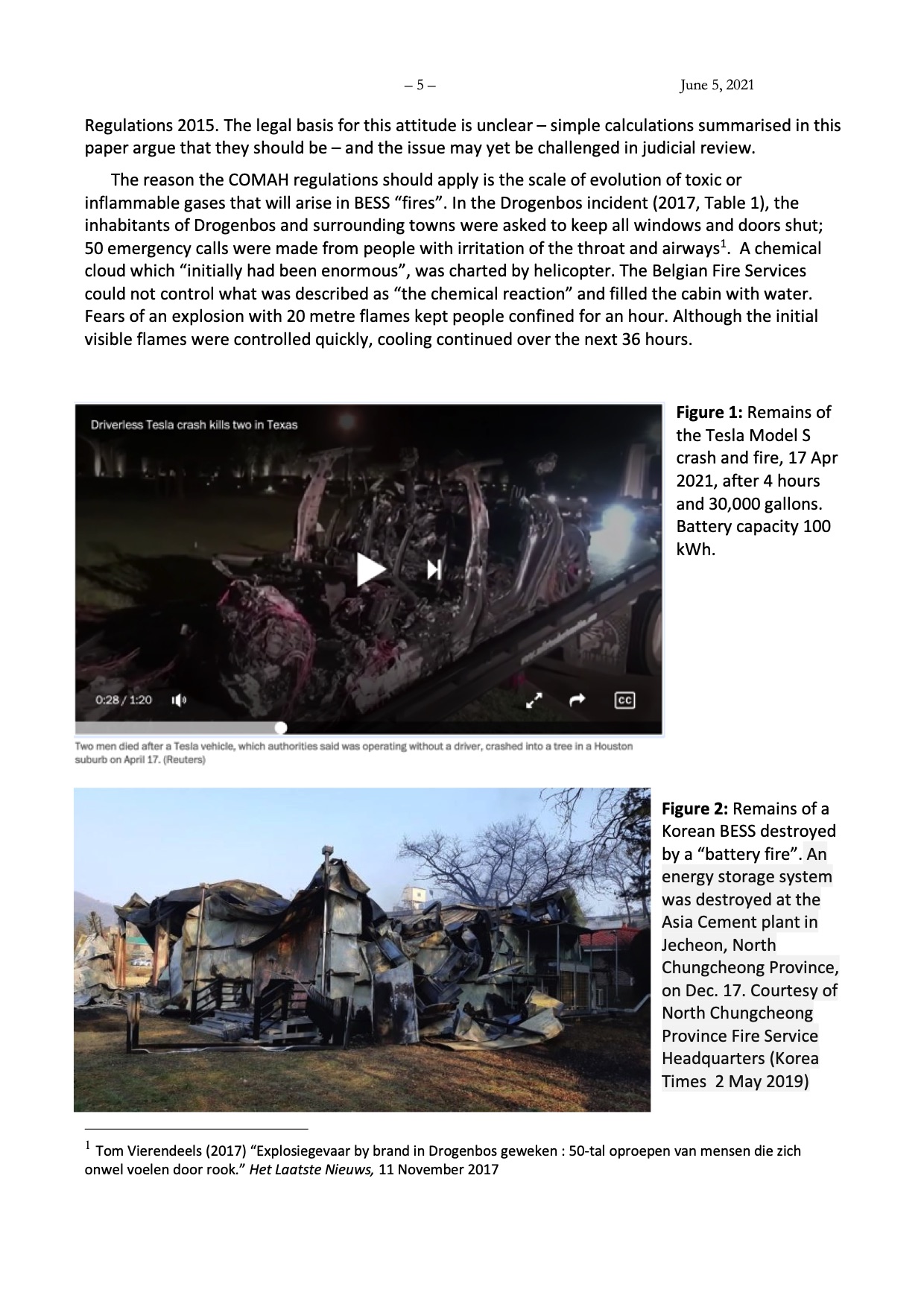
Figure 1: Remains of the Tesla Model S crash and fire, 17 Apr 2021, after 4 hours and 30,000 gallons. Battery capacity 100 kWh.
Figure 2: Remains of a Korean BESS destroyed by a “battery fire”. An
1 Tom Vierendeels (2017) “Explosiegevaar by brand in Drogenbos geweken : 50-tal oproepen van mensen die zich onwel voelen door rook.” Het Laatste Nieuws, 11 November 2017
energy storage system
was destroyed at the
Asia Cement plant in
Jecheon, North
Chungcheong Province,
on Dec. 17. Courtesy of
North Chungcheong
Province Fire Service
Headquarters (Korea
Times 2 May 2019)
|
