Page | 007 FINDINGS
Key findings on PPE exposure and cleaning effectiveness include:
• Up to 75 SVOCs were detected during testing, ranging from one-ring to five-ring PAHs. Tests with increased
dilution of air in the blast chamber had a lower amount of SVOCs present.
• Penetration of SVOCs through the outer layer of the gear tested to the vapor barrier layer is possible.
Water-based cleaning efficiency ranged from 21% to 92%. Many of the SVOCs penetrated the outer layer of the bunker gear, showing higher deposition in the vapor barrier. CO2-based cleaning was very effective, showing many compounds as undetected after cleaning.
• CO2-based cleaning proved effective in removing SVOCs that penetrated the outer layer of gear and were deposited in the vapor barrier.
The penetration of metallic particles to the vapor barrier level was very low. The outer layer of bunker gear proved effective in stopping most metals. All thermal liner values were near the detection limit.
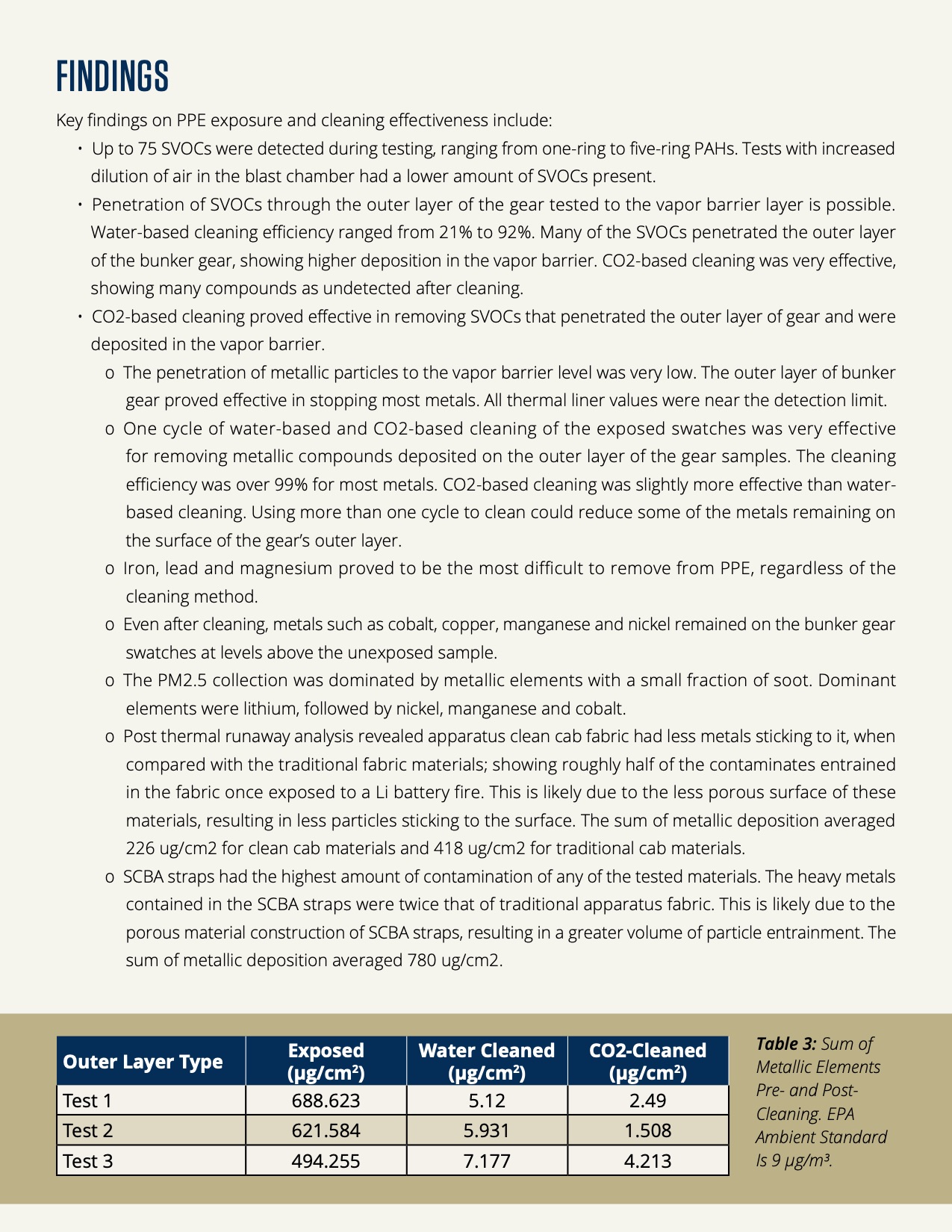
One cycle of water-based and CO2-based cleaning of the exposed swatches was very effective for removing metallic compounds deposited on the outer layer of the gear samples. The cleaning efficiency was over 99% for most metals. CO2-based cleaning was slightly more effective than water- based cleaning. Using more than one cycle to clean could reduce some of the metals remaining on the surface of the gear’s outer layer.
Iron, lead and magnesium proved to be the most difficult to remove from PPE, regardless of the cleaning method.
Even after cleaning, metals such as cobalt, copper, manganese and nickel remained on the bunker gear swatches at levels above the unexposed sample.
The PM2.5 collection was dominated by metallic elements with a small fraction of soot. Dominant elements were lithium, followed by nickel, manganese and cobalt.
Post thermal runaway analysis revealed apparatus clean cab fabric had less metals sticking to it, when compared with the traditional fabric materials; showing roughly half of the contaminates entrained in the fabric once exposed to a Li battery fire. This is likely due to the less porous surface of these materials, resulting in less particles sticking to the surface. The sum of metallic deposition averaged 226 ug/cm2 for clean cab materials and 418 ug/cm2 for traditional cab materials.
SCBA straps had the highest amount of contamination of any of the tested materials. The heavy metals contained in the SCBA straps were twice that of traditional apparatus fabric. This is likely due to the porous material construction of SCBA straps, resulting in a greater volume of particle entrainment. The sum of metallic deposition averaged 780 ug/cm2.
Table 3: Sum of Metallic Elements Pre- and Post- Cleaning. EPA Ambient Standard Is 9 μg/m3.
Outer Layer Type
Exposed (μg/cm2)
Water Cleaned (μg/cm2)
CO2-Cleaned (μg/cm2)
Test 1 688.623 5.12 2.49
Test 2 621.584 5.931 1.508
Test 3 494.255 7.177 4.213
|
