Salgenx

Lithium Ion Battery Fire and Explosion


Only You Can Prevent Lithium Energy Battery Fires
An alternative to Lithium Energy Storage Fires: The Salgenx Saltwater Battery: A revolutionary energy storage solution for grid-scale and sustainable power needs. No Lithium in the battery chemistry. With non-toxic, eco-friendly saltwater electrolytes, Salgenx offers high efficiency, durability, and safety for renewable energy integration. Ideal for large-scale storage, data centers, and off-grid systems.


Publication Title | Lithium Ion Battery Fire and Explosion

Grid Scale Storage Publications Search

Search Lithium Fire Publications search was updated real-time via Filemaker on:

Search Lithium Fire Publications | Return to Search List

Search Completed | Title | Lithium Ion Battery Fire and Explosion
Original File Name Searched: 8-375.pdf | Google It | Yahoo | Bing

Previous Page | Next Page
lithium-ion-battery-fire-and-explosion-003</TD> <TD valign=

Page | 003

hexafluorophosphate (LiPF6) is by far the most widely used electrolyte salt in lithium ion batteries. However, their thermal stability is poor even at moderately elevated temperatures of 60-85oC. The salt is believed to play the role of a mediator in the solution’s decomposition [5]. Such flammable materials are the fuels and easy ignited in air, once the batteries is blasted to fragment, then, there has the danger of fire under the effect of explosion energy.
(1) Rinsed Li0.5CoO2 at elevated temperature in argon
(2) 45mg Li0.5CoO2 with 45mg 1M LiPF6/EC+DEC(1:1 w/w)
at elevated temperature in argon
wolf ta
(2)
160
140
120
100
1- g W m/
80 60 40 20
0
-20
100 150
(1)
eH
200 250
300
Temperature / oC
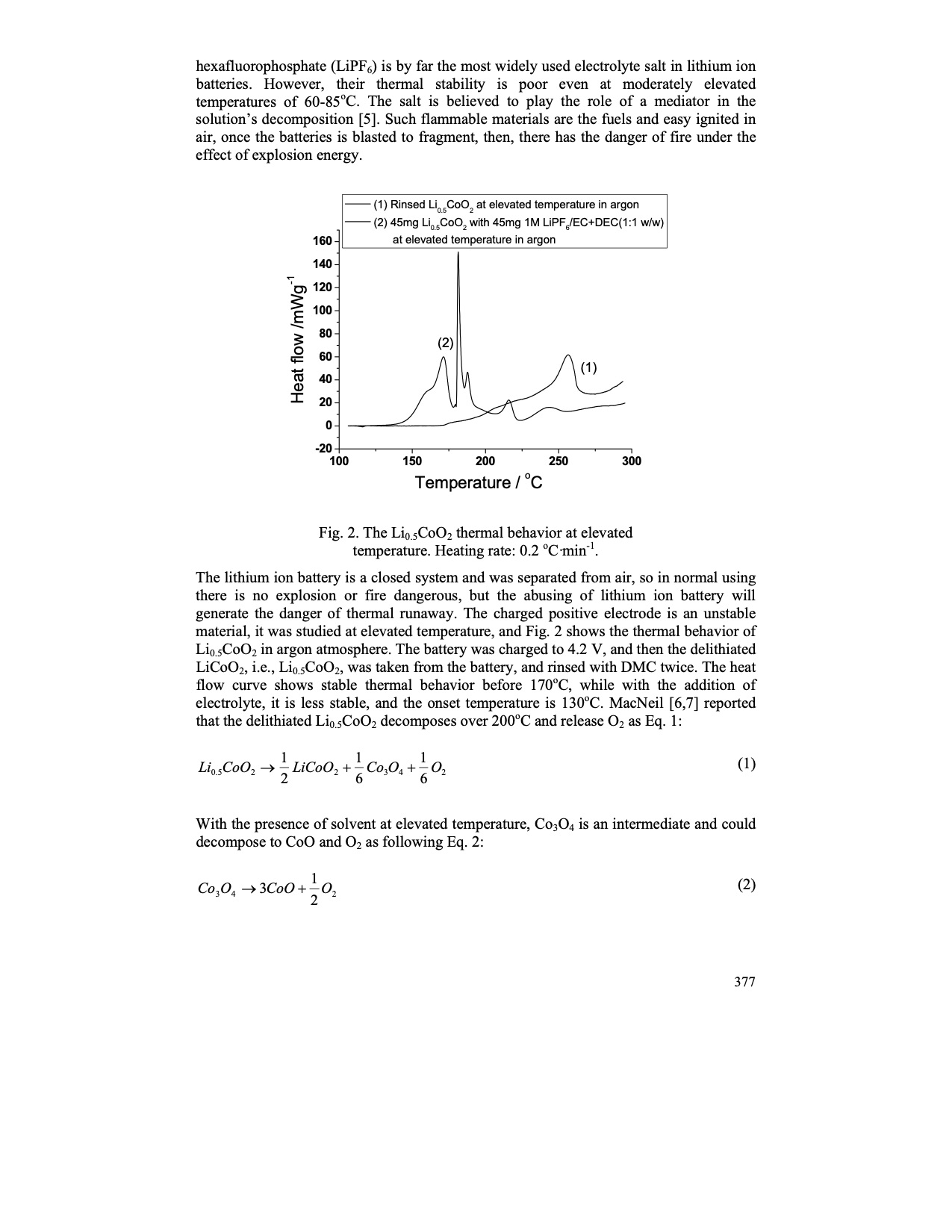
Fig. 2. The Li0.5CoO2 thermal behavior at elevated temperature. Heating rate: 0.2 oC·min-1.
The lithium ion battery is a closed system and was separated from air, so in normal using there is no explosion or fire dangerous, but the abusing of lithium ion battery will generate the danger of thermal runaway. The charged positive electrode is an unstable material, it was studied at elevated temperature, and Fig. 2 shows the thermal behavior of Li0.5CoO2 in argon atmosphere. The battery was charged to 4.2 V, and then the delithiated LiCoO2, i.e., Li0.5CoO2, was taken from the battery, and rinsed with DMC twice. The heat flow curve shows stable thermal behavior before 170oC, while with the addition of electrolyte, it is less stable, and the onset temperature is 130oC. MacNeil [6,7] reported that the delithiated Li0.5CoO2 decomposes over 200oC and release O2 as Eq. 1:
(1) Li0.5CoO2 → 12 LiCoO2 + 16 Co3O4 + 16 O2
With the presence of solvent at elevated temperature, Co3O4 is an intermediate and could decompose to CoO and O2 as following Eq. 2:
Co3O4 →3CoO+12O2
(2)
377

Search Contact: greg@salgenx.com