Search Completed | Title | FIRE PROTECTION EMERGENCY RESPONSE PLAN Lithium Ion BESS
Original File Name Searched: Emergency-Response-Plan-ERP-BESS-Tesla-Draft_v1.pdf | Google It | Yahoo | Bing
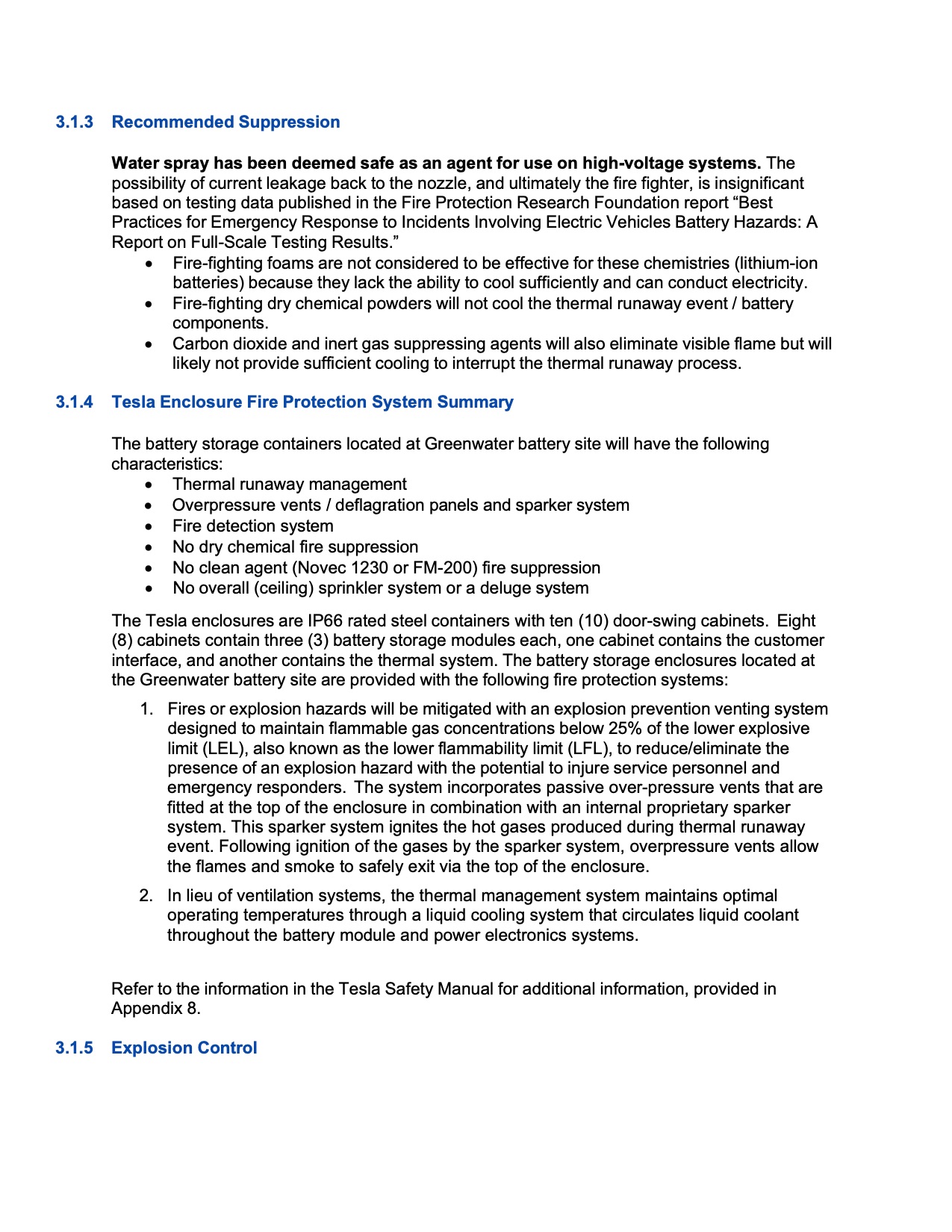
Page | 015 3.1.3 Recommended Suppression
Water spray has been deemed safe as an agent for use on high-voltage systems. The possibility of current leakage back to the nozzle, and ultimately the fire fighter, is insignificant based on testing data published in the Fire Protection Research Foundation report “Best Practices for Emergency Response to Incidents Involving Electric Vehicles Battery Hazards: A Report on Full-Scale Testing Results.”
• Fire-fighting foams are not considered to be effective for these chemistries (lithium-ion batteries) because they lack the ability to cool sufficiently and can conduct electricity.
• Fire-fighting dry chemical powders will not cool the thermal runaway event / battery components.
• Carbon dioxide and inert gas suppressing agents will also eliminate visible flame but will likely not provide sufficient cooling to interrupt the thermal runaway process.
3.1.4 Tesla Enclosure Fire Protection System Summary
The battery storage containers located at Greenwater battery site will have the following characteristics:
• Thermal runaway management
• Overpressure vents / deflagration panels and sparker system • Fire detection system
• No dry chemical fire suppression
• No clean agent (Novec 1230 or FM-200) fire suppression
• No overall (ceiling) sprinkler system or a deluge system
The Tesla enclosures are IP66 rated steel containers with ten (10) door-swing cabinets. Eight (8) cabinets contain three (3) battery storage modules each, one cabinet contains the customer interface, and another contains the thermal system. The battery storage enclosures located at the Greenwater battery site are provided with the following fire protection systems:
1. Fires or explosion hazards will be mitigated with an explosion prevention venting system designed to maintain flammable gas concentrations below 25% of the lower explosive limit (LEL), also known as the lower flammability limit (LFL), to reduce/eliminate the presence of an explosion hazard with the potential to injure service personnel and emergency responders. The system incorporates passive over-pressure vents that are fitted at the top of the enclosure in combination with an internal proprietary sparker system. This sparker system ignites the hot gases produced during thermal runaway event. Following ignition of the gases by the sparker system, overpressure vents allow the flames and smoke to safely exit via the top of the enclosure.
2. In lieu of ventilation systems, the thermal management system maintains optimal operating temperatures through a liquid cooling system that circulates liquid coolant throughout the battery module and power electronics systems.
Refer to the information in the Tesla Safety Manual for additional information, provided in Appendix 8.
3.1.5 Explosion Control
|
