Salgenx

EPRI Battery Energy Storage Systems (BESS) Failure Incident Database


Only You Can Prevent Lithium Energy Battery Fires
An alternative to Lithium Energy Storage Fires: The Salgenx Saltwater Battery: A revolutionary energy storage solution for grid-scale and sustainable power needs. No Lithium in the battery chemistry. With non-toxic, eco-friendly saltwater electrolytes, Salgenx offers high efficiency, durability, and safety for renewable energy integration. Ideal for large-scale storage, data centers, and off-grid systems.


Publication Title | EPRI Battery Energy Storage Systems (BESS) Failure Incident Database

Grid Scale Storage Publications Search

Search Lithium Fire Publications search was updated real-time via Filemaker on:

Search Lithium Fire Publications | Return to Search List

Search Completed | Title | EPRI Battery Energy Storage Systems (BESS) Failure Incident Database
Original File Name Searched: BESS_FailureIncidentDatabase_AnalysisofFailureRootCause.pdf | Google It | Yahoo | Bing

Previous Page | Next Page
epri-battery-energy-storage-systems-bess-failure-incident-da-007</TD> <TD valign=

Page | 007

Between 2017 and 2018, the lithium ion BESS deployments increased by ~1 GW, more than doubling total global de- ployment, and signaling the advent of the commercial BESS industry.8 The period between 2017-2019 also experienced a spike in BESS failure incidents. Of the 30 incidents in the database between 2018 and 2019, 27 occurred in South Ko- rea. The Korean government had provided strong economic incentives for BESS, especially paired with solar PV genera- tion. The number of installed BESS in South Korea rose from 30 in 2013 to 947 in 2018. The rapid deployment was not accompanied by robust safety standards and regulations, which contributed to the failures.9 After the first spate of fires, the South Korean government investigated the
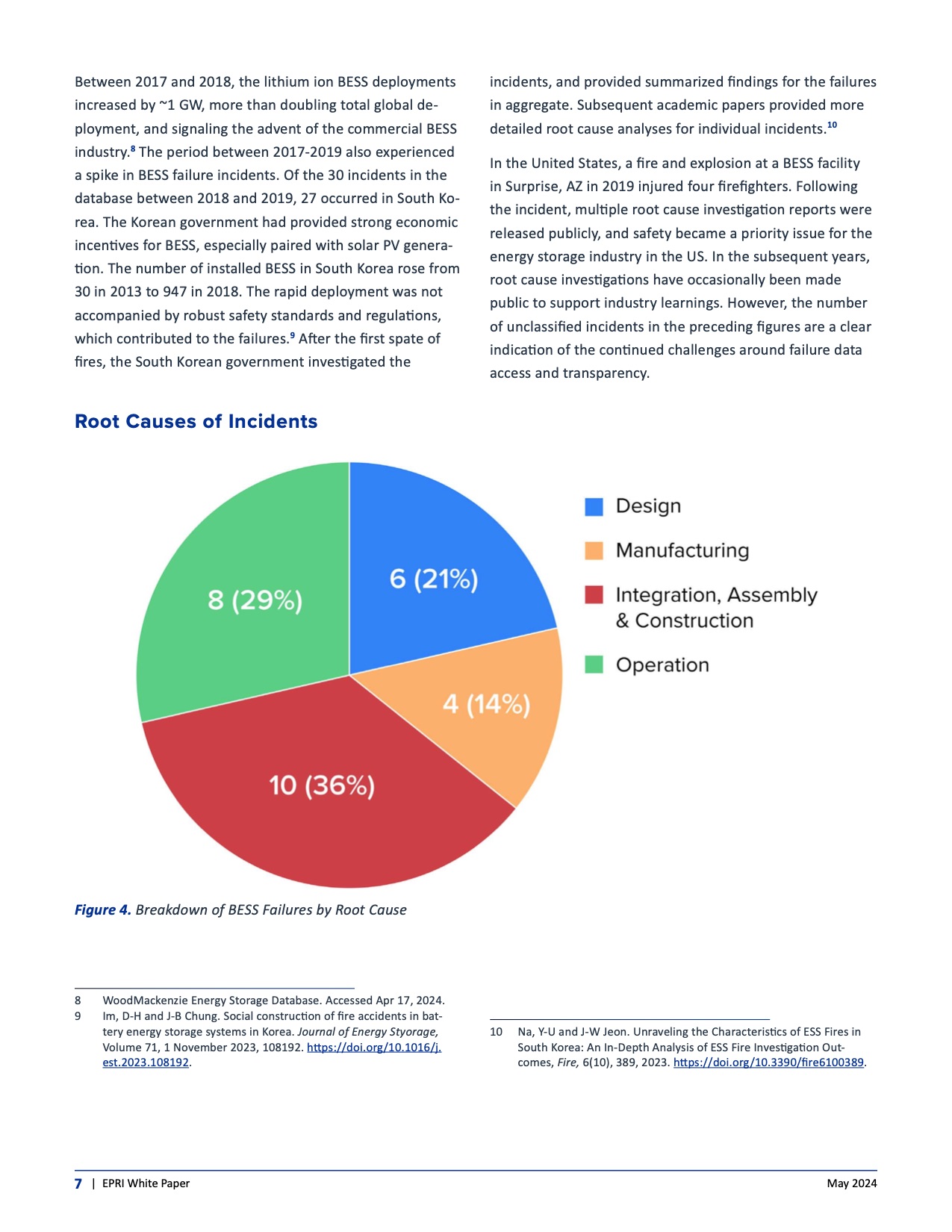
Root Causes of Incidents
incidents, and provided summarized findings for the failures in aggregate. Subsequent academic papers provided more detailed root cause analyses for individual incidents.10
In the United States, a fire and explosion at a BESS facility in Surprise, AZ in 2019 injured four firefighters. Following the incident, multiple root cause investigation reports were released publicly, and safety became a priority issue for the energy storage industry in the US. In the subsequent years, root cause investigations have occasionally been made public to support industry learnings. However, the number of unclassified incidents in the preceding figures are a clear indication of the continued challenges around failure data access and transparency.
Figure 4. Breakdown of BESS Failures by Root Cause
8 WoodMackenzie Energy Storage Database. Accessed Apr 17, 2024.
9 Im, D-H and J-B Chung. Social construction of fire accidents in bat- tery energy storage systems in Korea. Journal of Energy Styorage, Volume 71, 1 November 2023, 108192. https://doi.org/10.1016/j. est.2023.108192.
10
Na, Y-U and J-W Jeon. Unraveling the Characteristics of ESS Fires in South Korea: An In-Depth Analysis of ESS Fire Investigation Out- comes, Fire, 6(10), 389, 2023. https://doi.org/10.3390/fire6100389.
7 | EPRI White Paper 15256168
May 2024

Search Contact: greg@salgenx.com